Welcome to the exciting world of inline skating! Whether you’re an adult looking for a new, engaging way to exercise or a parent introducing your child to a lifetime of fun, inline skating offers a fantastic blend of physical activity, skill development, and pure joy. This comprehensive guide is designed to be your ultimate resource, taking you from the crucial first step of selecting the right skates to mastering the fundamental techniques that will have you gliding with confidence. We will cover every detail, ensuring you have the knowledge to make informed decisions and a clear path for progression.
Why Choose Inline Skating? A Path to Fun and Fitness
Inline skating is more than just a recreational activity; it’s a powerful tool for growth and health. For children, it’s a gateway to developing crucial motor skills, balance, and coordination. The process of learning to skate builds resilience and boosts self-esteem as they overcome challenges and achieve new milestones. For adults, it’s a low-impact cardiovascular workout that strengthens the core, legs, and glutes without the harsh impact of running. Beyond the physical benefits, skating is an excellent way to relieve stress, enjoy the outdoors, and connect with family and friends in a fun, active setting. It fosters a sense of freedom and accomplishment that few other activities can match.

The Ultimate Guide to Choosing Your First Inline Skates
Selecting your first pair of inline skates is the most critical decision in your journey. The right skates provide comfort, support, and performance, making the learning process enjoyable. The wrong pair can lead to discomfort, frustration, and even injury. This section breaks down the essential components and considerations to help you choose wisely for yourself or your child.
Hard Shell vs. Soft Shell Boots: The Core Decision
The boot is the foundation of the skate, and the primary choice is between a hard shell and a soft shell design. Each has distinct advantages tailored to different needs.
- Hard Shell Skates: These feature a rigid, durable plastic exterior, providing maximum ankle support and protection. This makes them an excellent choice for beginners and especially for children, as the sturdy structure helps prevent ankle rolling and provides a stable base for learning. Hard shell boots are also very durable and can withstand the inevitable scuffs and falls of the learning process.
- Soft Shell Skates: These are constructed with a more flexible, breathable material, similar to an athletic shoe. They offer superior comfort and ventilation, making them a popular choice for fitness and long-distance skaters. While they provide less lateral support than hard shells, modern designs incorporate supportive cuffs and strapping systems to ensure stability.
Deconstructing the Skate: Wheels, Bearings, and Frames
Understanding the components that make you roll is key to selecting a skate that matches your goals.
- Wheels: Two factors define a wheel: size (diameter in mm) and hardness (durometer, rated “A”). For beginners, smaller wheels (around 72-80mm) are ideal as they offer a lower center of gravity, which enhances stability and makes control easier. Softer wheels (around 78A-82A) provide better grip and shock absorption, creating a smoother ride on varied surfaces.
- Bearings: Bearings are the small metal rings inside the wheel hub that allow them to spin freely. They are typically rated using the ABEC scale (e.g., ABEC-3, ABEC-5, ABEC-7). A higher ABEC rating indicates tighter manufacturing tolerances and potentially a smoother, faster glide. For beginners, an ABEC-3 or ABEC-5 rating is more than sufficient and provides a controlled speed that is perfect for learning.
- Frames: The frame holds the wheels and connects them to the boot. Most beginner and recreational skates use a plastic or composite frame, which is lightweight and effective at absorbing vibrations. More advanced skates may use aluminum frames, which are stiffer and offer better power transfer, but this is not a necessary feature for a first pair.
Getting the Perfect Fit: Sizing for Adults and Children
A proper fit is non-negotiable for both comfort and safety. Skates should be snug without being painfully tight. Your toes should be close to the end of the boot but not curled or crammed. When you bend your knees into a skating stance, your heel should lock into the back of the boot. For children, adjustable skates are a fantastic investment. These skates can typically expand across 3-4 different shoe sizes, accommodating growing feet and extending the life of the purchase. Always measure your child’s foot and consult the manufacturer’s specific sizing chart, as skate sizing can differ from standard shoe sizes.
The Critical Role of Brakes
For any beginner, a reliable brake is essential. Most entry-level inline skates come with a pre-installed heel brake, usually on the right skate. This is the simplest and most intuitive stopping method to learn. Ensure the skate you choose has a brake, and as you advance, you can learn other stopping techniques. Some skaters eventually remove the brake, but it is an indispensable safety tool when you are starting out.

Safety First: Essential Protective Gear You Can’t Skip
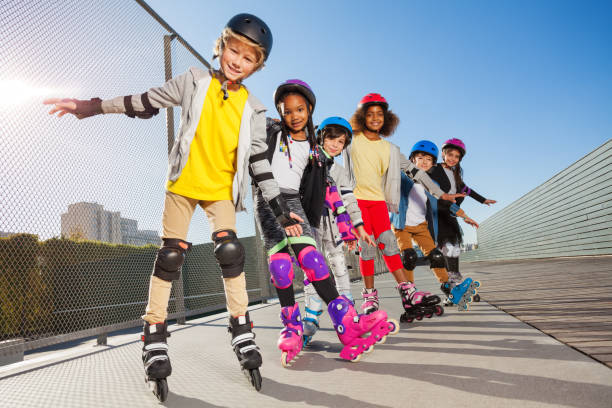
Before you even put on your skates, you must have the right protective gear. Falling is a natural and unavoidable part of learning to skate, and proper gear turns a potentially painful fall into a minor, non-injurious event. Wearing full protective gear every time you skate is the most important habit you can build.
- Helmet: This is the most crucial piece of safety equipment. Ensure you have a certified helmet that fits snugly and is worn correctly, sitting level on your head and with the straps securely fastened.
- Wrist Guards: When you fall, your first instinct is to put your hands out. Wrist guards have a hard plastic splint that protects your wrists from sprains and fractures. They are absolutely essential.
- Knee Pads and Elbow Pads: These protect your joints from impact and scrapes. Learning to fall onto your padded knees is a key safety skill, and these pads make it possible to do so without injury.
Make it a rule: no gear, no skating. This instills a safety-first mindset from the very beginning and drastically reduces the risk of serious injury, allowing you to learn with confidence.
Mastering the Fundamentals: Your First Steps on Wheels
With your skates and safety gear on, it’s time to get rolling. The key is to start slowly and focus on balance before speed. Find a safe, flat, and smooth area to practice, such as an empty tennis court or a smooth paved path, away from traffic and pedestrians.
The “Ready Position”: Finding Your Stance and Balance
The correct stance is the foundation for all other skills. Start on a soft surface like grass to prevent your wheels from rolling.
- Stand with your feet shoulder-width apart.
- Bend your knees deeply, as if you are about to sit in a chair.
- Lean your upper body slightly forward, keeping your shoulders over your knees.
- Keep your arms out in front of you for balance.
This “ready position” lowers your center of gravity and provides a stable base. Practice holding this position until you feel comfortable and balanced.
Learning to Fall Safely
Knowing how to fall correctly removes the fear and prevents injury. Practice falling on grass first. The goal is to fall to the side or forward, not backward. Try to land on your padded knees and wrist guards, absorbing the impact with your protective gear. Falling is part of the sport, and learning to do it safely is a skill in itself.
From Walking to Gliding: The V-Walk Technique
Once you’re comfortable with your stance on a hard surface, it’s time to move. Don’t try to skate normally at first. Instead, use the “V-walk” or “duck walk.”
- Point your toes outward, creating a “V” shape with your skates.
- Take small steps, lifting one foot at a time and placing it down in front of the other.
- Keep your knees bent and your weight forward.
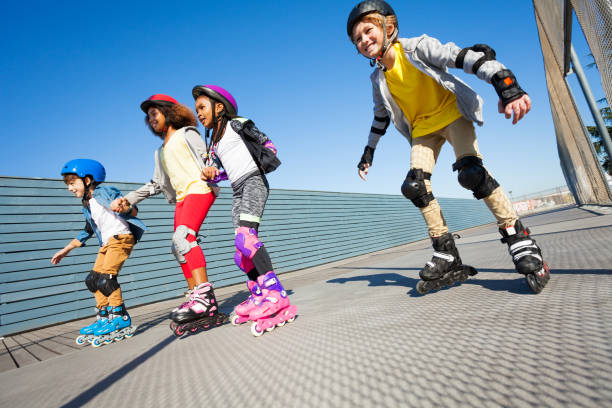
- As you get more comfortable, try to push off with each step, turning the walk into a short glide. This push-and-glide motion is the essence of the skating stride.
Essential Skills for Control: Braking and Turning
Once you can glide, the next step is learning to control your speed and direction. These skills are crucial for skating safely in any environment.
How to Stop: Mastering the Heel Brake
The heel brake is the most reliable stopping method for beginners. Practice this at a very slow speed until it becomes second nature.
- Get into your ready position while gliding slowly.
- Scissor your feet, bringing the skate with the brake (usually the right one) forward.
- Keeping most of your weight on your back (left) leg, lift the toes of your front (right) foot.
- Press down firmly on the heel brake pad. The more pressure you apply, the faster you will stop.
It’s important to keep your knees bent and body weight low throughout the braking motion to maintain balance.
Advanced Braking: The T-Stop and Plow Stop
As you gain confidence, you can explore other braking methods. The T-Stop involves dragging one skate behind the other, perpendicular to the direction of travel, using the wheels to create friction. The Plow Stop involves pointing your toes inward (“pigeon-toed”) and pushing your skates outward to slow down, similar to snowplowing on skis. These methods require more balance and edge control and should be practiced after the heel brake is mastered.
Navigating Your Path: The A-Frame Turn
The simplest way to turn is the A-Frame Turn. While gliding, get into your ready position with your feet wider than your shoulders. To turn right, simply lean to the right and apply more pressure to the inside edge of your left skate and the outside edge of your right skate. Your body and skates will naturally follow the direction you lean. Look where you want to go, and your body will follow.

The Journey to Confidence: Practice and Progression
Becoming a confident inline skater is a journey, not a race. The key to improvement is consistent, patient practice. Start with short sessions of 15-20 minutes and gradually increase the duration as your strength and stamina improve. Don’t be discouraged by falls or slow progress; every skater, even the professionals, started as a beginner. Celebrate small victories, whether it’s gliding for ten feet without wobbling or executing your first successful stop. Set small, achievable goals for each practice session. As you master the basics, you can challenge yourself by skating on gentle slopes or learning more advanced maneuvers. Remember to always have fun—that’s what skating is all about.

Frequently Asked Questions (FAQ)
- What is the most important piece of advice for a total beginner?
- The single most important piece of advice is to wear full protective gear every single time you skate, especially a helmet and wrist guards. Beyond that, learn in a safe, flat, open area and master the “ready position” (knees bent, leaning forward) and how to use your heel brake before attempting to skate in more challenging environments. Patience is key; don’t rush the fundamentals.
- Should I choose hard shell or soft shell skates for my child?
- For children, hard shell skates are almost always the better choice. The rigid outer boot provides superior ankle support, which is crucial for developing ankles and helps prevent common injuries. They are also far more durable and can withstand the wear and tear of learning. Look for a pair with an adjustable sizing feature to accommodate your child’s growth.
- How do I know if the inline skates fit correctly?
- A proper fit should be snug and secure, much like a ski boot. Your heel should be locked into the back of the skate with minimal lift. Your toes should be able to wiggle slightly but should be very close to, or lightly brushing, the end of the liner. There should be no major pressure points or pinching. It’s best to try skates on with the type of socks you plan to wear while skating.
- What’s the difference between 3-wheel and 4-wheel skates for a beginner?
- For a beginner, 4-wheel skates are the standard and recommended choice. The four smaller wheels provide a longer wheelbase and a lower center of gravity, which significantly increases stability and makes it easier to balance. Three-wheel skates (or “triskates”) typically have larger wheels, making them faster and more maneuverable, but they are less stable and better suited for intermediate to advanced skaters.
- How often should I practice to see improvement?
- Consistency is more important than duration. Practicing for 20-30 minutes, 2-3 times per week, will yield much better results than one long, infrequent session. This allows your muscles to develop memory and your body to adapt to the unique balance requirements of skating without causing burnout or excessive soreness.